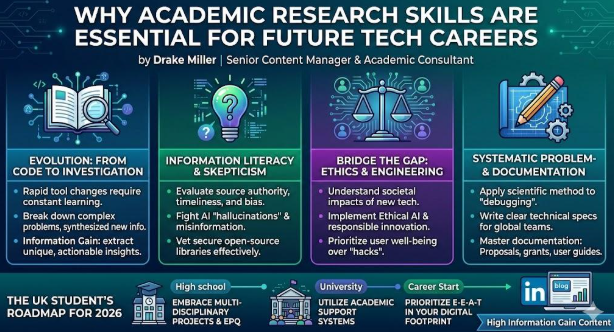
The tech industry of 2026 is no longer just about writing lines of code or mastering a specific software suite. As artificial intelligence, quantum computing, and decentralised systems become the backbone of our global economy, the nature of technical roles has shifted. For high school and university students in the UK looking to break into this space, there is a surprising “superpower” that often goes overlooked in favour of technical certifications: academic research skills.
While technical proficiency gets you through the door, research skills ensure you stay in the room. From navigating the complexities of “Agentic AI” to solving unprecedented ethical dilemmas in data privacy, the ability to conduct rigorous, evidence-based inquiry is what separates a technician from a tech leader.
The Evolution of Tech: From Implementation to Investigation
In previous decades, a career in tech often followed a predictable path: learn a language, build a product, and maintain it. Today, the pace of innovation is so rapid that the tools students learn in their first year of university may be obsolete by the time they graduate.
Academic research teaches the most vital skill for this environment: learning how to learn. When a student engages in academic research—whether it is for a history thesis, a chemistry lab report, or an Extended Project Qualification (EPQ)—they are practising the art of breaking down complex problems, identifying credible sources, and synthesising new information. In the tech world, this translates directly to “Information Gain,” the ability to take a sea of raw data and extract unique, actionable insights that haven’t been automated by an algorithm.
For students balancing rigorous technical modules with complex financial modules, seeking accounting assignment help can often provide a practical template for how to structure such data-heavy research projects effectively.
1. Information Literacy and the Fight Against Hallucination
As AI-powered search and generative tools become the primary way we interact with information, the risk of “hallucinations” and misinformation has skyrocketed. For a software engineer or a data scientist, relying on a faulty data set or an unverified AI output can lead to catastrophic system failures.
Academic research trains students to be professional skeptics. UK students are taught to evaluate sources based on authority, timeliness, and bias. In a professional tech setting, this “researcher mindset” is essential for:
- Vetting Open-Source Libraries: Ensuring that the code being integrated into a project is secure and well-maintained.
- Fact-Checking AI Outputs: Verifying that a machine-learning model’s suggestions are grounded in reality.
- Competitor Analysis: Understanding the market landscape through objective data rather than marketing hype.
2. Bridging the Gap Between Ethics and Engineering
The UK’s tech sector is increasingly focused on “Ethical AI” and responsible innovation. Future tech workers cannot operate in a vacuum; they must understand the societal implications of their work.
Academic research involves deep dives into ethics and peer reviews. When a student researches the impact of social media on mental health, they are building the foundation for a future role as a Product Manager who prioritises user well-being over “engagement hacks.” Research skills allow tech professionals to look beyond the how of a product and investigate the why.
3. Mastering Documentation and Communication
One of the most significant hurdles in large-scale tech projects is “knowledge debt”—when information is siloed or poorly explained. Academic research requires a high level of formal documentation, from bibliographies to methodology sections.
Students who excel at academic writing are naturally better at:
- Writing Clean Technical Specs: Ensuring that a team of 50 developers can follow a single vision.
- Grant and Proposal Writing: Securing funding for startups by clearly articulating the value proposition.
- User Documentation: Creating guides that make complex technology accessible to non-technical users.
4. Problem-Solving Through Systematic Methodology
In computer science, “debugging” is essentially a form of research. You observe a phenomenon (a bug), form a hypothesis (the cause), test it, and document the result. This is the Scientific Method in action.
By leaning into academic research during their formative years, students develop a systematic approach to problem-solving. This methodology is crucial for emerging fields like BioTech and GreenTech, where the solutions aren’t just in the code, but in the intersection of digital systems and physical reality.
See also: enhance business with technology
The UK Student’s Roadmap for 2026
For students currently in the UK education system, the transition from classroom research to career success involves a few key steps:
- Embrace Multi-Disciplinary Projects: Don’t just stick to STEM. A student who understands sociopolitics or economics will be a more effective tech strategist.
- Focus on the EPQ: For high school students, the EPQ is a goldmine for demonstrating independent inquiry to universities and future employers.
- Utilise Academic Support Systems: Whether it’s through university libraries or professional assignment help UK services , learning how to leverage expert resources is a professional skill in itself.
- Prioritise E-E-A-T in Your Digital Footprint: Showcasing your research through a blog or LinkedIn profile can significantly boost your “searchability” to recruiters.
Conclusion: The Researcher is the Future Developer
The “Future Tech Career” is no longer a static destination. It is a journey of continuous discovery. Academic research skills provide the framework for the human element—the ability to ask the right questions and find the truth. For those aiming to lead the next wave of innovation in the UK and beyond, your ability to conduct a thorough literature review today might just be the secret to building the world-changing app of tomorrow.
Frequently Asked Questions
Q.1 How do academic research skills specifically help with coding?
Research is about problem-solving. In a professional environment, you aren’t just writing code; you are investigating why a bug exists and researching the most efficient libraries to use. This treats every error as a hypothesis to be tested.
Q.2 Can an EPQ help me get a tech job in the UK?
Yes. Highlighting an EPQ on your CV demonstrates the self-discipline and analytical rigour required for high-level technical research and “Product Management” roles.
Q.3 What is “Information Gain,” and why is it important in 2026?
Search engines now prioritise “Information Gain”—the inclusion of unique insights. Academic research teaches you how to find the “hidden” data points that AI might miss.
Q.4 Is academic research still relevant with the rise of AI search?
It is more relevant than ever. As AI tools become prone to “hallucinations,” the human ability to fact-check and verify sources becomes a premium skill in the UK job market.